Welcome to DU!
The truly grassroots left-of-center political community where regular people, not algorithms, drive the discussions and set the standards.
Join the community:
Create a free account
Support DU (and get rid of ads!):
Become a Star Member
Latest Breaking News
Editorials & Other Articles
General Discussion
The DU Lounge
All Forums
Issue Forums
Culture Forums
Alliance Forums
Region Forums
Support Forums
Help & Search
General Discussion
Related: Editorials & Other Articles, Issue Forums, Alliance Forums, Region Forums
Democrats will lose ground in the 2030 census - Decision Desk HQ
https://decisiondeskhq.substack.com/p/democrats-lose-ground-2030-apportionment-census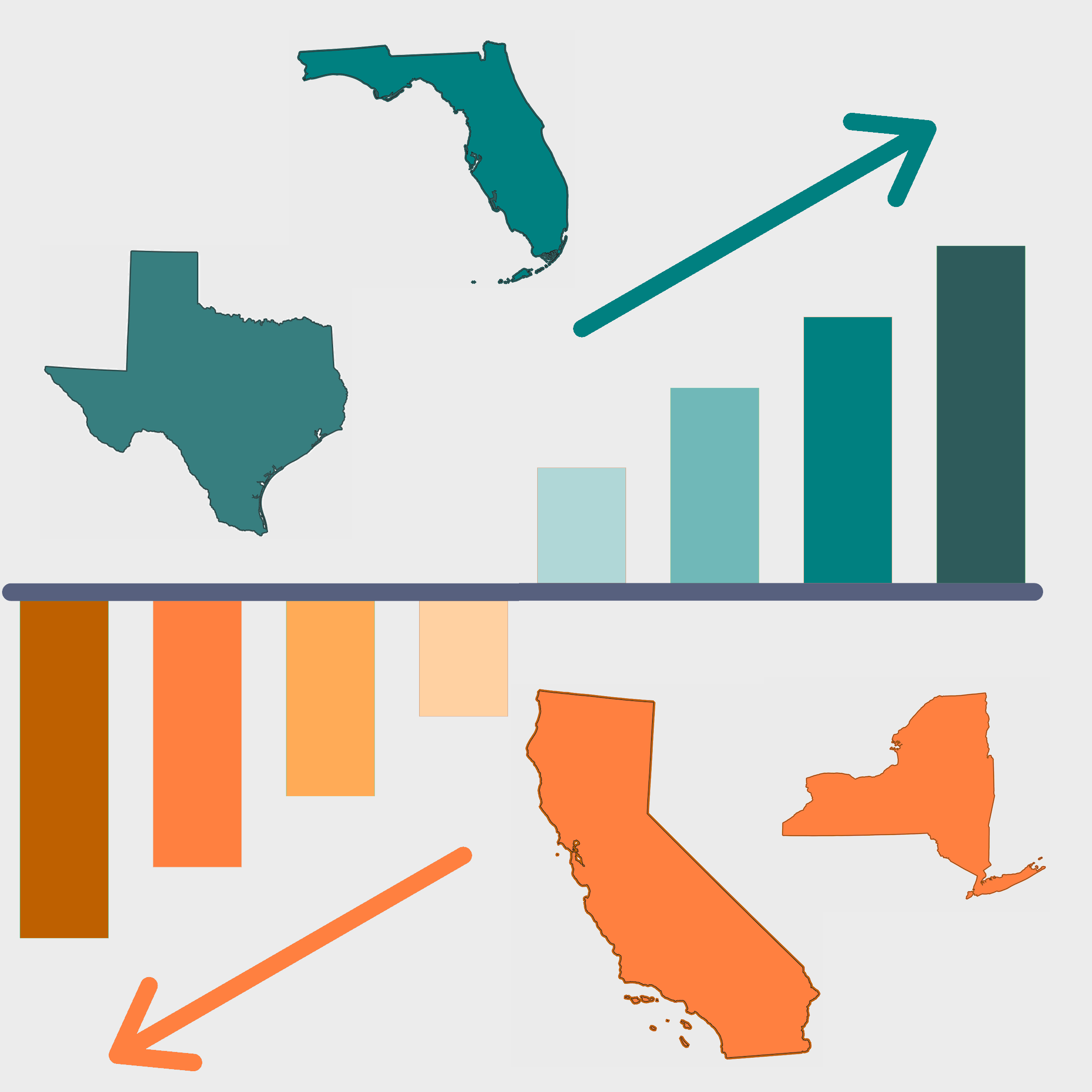
Quick summary:
New projections for the 2030 apportionment suggest that red states will likely gain U.S. House seats and blue states will probably lose ground. In the projections, Texas gains four seats, Florida gains two to four, and Arizona, Georgia, and North Carolina each gain one. Conversely, California is on pace to lose four seats, while New York and Illinois might lose one to two.
The projected seat changes will affect the Electoral College, too. They would increase Donald Trump’s 2024 electoral vote haul to 322, up 10 votes from his actual result. While political conditions could change quite a bit by 2032, this would lower the bar for what the GOP needs to win. In 2024, Republicans needed to win at least four of the seven key swing states to win the presidency, including the tipping-point state of Pennsylvania. But under these projections, Republicans would only have needed the Sun Belt trio of Arizona, Georgia, and North Carolina.
Last week, the Census Bureau released new estimates for the population of the United States and its individual states. While overall growth slowed, state-level trends remained largely similar: The fastest-growing states are in the Sun Belt and Interior West, while slower-growing (or shrinking) states are mainly found along the West Coast and across the Frost Belt.
Naturally, these trends will have political ramifications. Different organizations and experts quickly took the updated population estimates and made projections about the apportionment of seats in the U.S. House of Representatives after the 2030 census. Using somewhat different approaches, redistricting expert Jonathan Cervas of Carnegie Mellon University, the Brennan Center for Justice, and the American Redistricting Project all released projections detailing the potential gains and losses each state might experience in the next round of reapportionment. And on the whole, states that President Donald Trump carried in 2024 are in line to gain ground, while states that then-Vice President Kamala Harris won look set to lose it.
The projections differed in small ways, but broadly agreed about the likely state gainers and losers. Taking the median change of these projections, Texas (four seats) and Florida (three seats) appear on their way to the biggest gains, while Georgia and North Carolina could each add one seat. Three states in the Interior West — Arizona, Idaho, and Utah — are also on course to gain one apiece. Conversely, the biggest loser is likely to be California, which is trending toward a four-seat decline, and New York, which could lose two. Six other states — Illinois, Minnesota, Oregon, Pennsylvania, Rhode Island, and Wisconsin — are projected to each subtract one seat.
Link to tweet
5 replies
 = new reply since forum marked as read
Highlight:
NoneDon't highlight anything
5 newestHighlight 5 most recent replies
= new reply since forum marked as read
Highlight:
NoneDon't highlight anything
5 newestHighlight 5 most recent replies
= new reply since forum marked as read
Highlight:
NoneDon't highlight anything
5 newestHighlight 5 most recent replies
Democrats will lose ground in the 2030 census - Decision Desk HQ (Original Post)
In It to Win It
Yesterday
OP

maxsolomon
(38,377 posts)1. 2030 is a long way off,
And there's naught to do about it.

newdeal2
(5,011 posts)2. I hate these census headlines
Because these estimates often get revised significantly and the big blue cities end up doing okay.
Bigger picture: the Democratic party needs to figure out how to win at all levels in Florida and Texas. This is a problem that can’t be ignored.
maxsolomon
(38,377 posts)3. Can Texans and Floridians become better people who don't vote Repuke?
Both those states are going to be Gerrymandered to the Nth degree by 2030, and then it will be cranked even tighter after the Census is issued.
newdeal2
(5,011 posts)5. My understanding is often they run unopposed
There’s one issue. Quality candidates could be another. Lack of funding or national investment of time and money.
Giving up or hoping for a better outcome is not an option anymore.

synni
(701 posts)4. Let's move to California!
I used to live there, and the weather is great.