Welcome to DU!
The truly grassroots left-of-center political community where regular people, not algorithms, drive the discussions and set the standards.
Join the community:
Create a free account
Support DU (and get rid of ads!):
Become a Star Member
Latest Breaking News
Editorials & Other Articles
General Discussion
The DU Lounge
All Forums
Issue Forums
Culture Forums
Alliance Forums
Region Forums
Support Forums
Help & Search
General Discussion
Related: Editorials & Other Articles, Issue Forums, Alliance Forums, Region Forums
Fulton Co's petition for return of seized voting records: "Fourth Amdt requires 'probable cause,' not 'possible cause."
Last edited Tue Feb 17, 2026, 05:26 PM - Edit history (1)
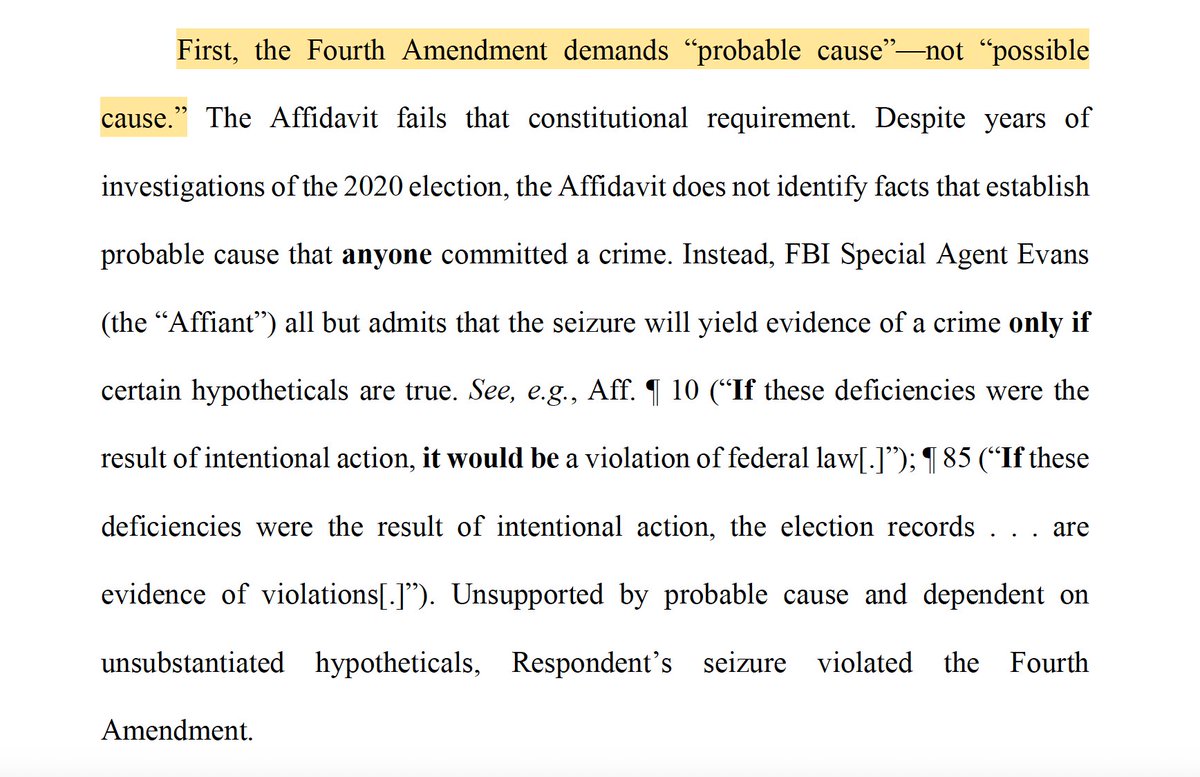
Roger Parloff @rparloff 3hFulton Co's amended petition for return of seized voting records: "First, the Fourth Amendment requires 'probable cause,' not 'possible cause.'"

UNITED STATES DISTRICT COURT FOR THE NORTHERN DISTRICT OF GEORGIA ATLANTA DIVISION ROBERT L. “ROBB ” P ITTS , CHAIRMAN, FULTON COUNTY BOARD OF COMMISSIONERS ; FULTON COUNTY BOARD OF REGISTRATION AND ELECTIONS ; and F ULTON C OUNTY, GEORGIA, Petitioners, v. UNITED STATES OF AMERICA
On January 28, 2026, the U.S. Department of Justice obtained a search warrant unprecedented in American history to seize the original—and only—copy of Fulton County’s 2020 election records. Now unsealed, the Affidavit (Doc. 22-2) confirms that the warrant is equally unprecedented in its theory of probable cause, subjecting Petitioners to an improper and unjustified seizure of their property in violation of the Fourth Amendment.
The seizure, which callously disregarded Petitioners’ constitutional rights, requires immediate equitable relief from this Court—namely, an order directing Respondent to return the original copy of the seized election records and other relief described below.
First, the Fourth Amendment demands “probable cause”—not “possible cause.” The Affidavit fails that constitutional requirement. Despite years of investigations of the 2020 election, the Affidavit does not identify facts that establish probable cause that anyone committed a crime. Instead, FBI Special Agent Evans (the “Affiant”) all but admits that the seizure will yield evidence of a crime only if certain hypotheticals are true.
“If these deficiencies were the result of intentional action, it would be a violation of federal law. (“If these deficiencies were the result of intentional action, the election records . . . are evidence of violations.”). Unsupported by probable cause and dependent on unsubstantiated hypotheticals, Respondent’s seizure violated the Fourth Amendment.
Second, instead of alleging probable cause to believe a crime has been committed, the Affidavit does nothing more than describe the types of human errors that its own sources confirm occur in almost every election—without any intentional wrongdoing whatsoever. Mislabeling an expected margin of error as “deficiencies” or “defects” cannot establish probable cause, let alone for a seizure of this magnitude.
Third, the Affidavit omits numerous material facts—including from the very reports and publicly-disclosed investigations that the Affiant cites—that confirm the alleged conduct was previously investigated and found to be unintentional. Moreover, the Affidavit not only fails to allege that any particular witness is reliable or credible; it omits discrediting information about those witnesses that was obviously available to the Affiant.
These omissions are serious. The ex parte warrant process would be rendered a nullity if the government were permitted to hide material and probative facts that refute probable cause from a magistrate judge and nevertheless retain the fruits of its misconduct.
Fourth, even if the Affidavit established probable cause, the seizure of original election materials would be unreasonable and in callous disregard of the Fourth Amendment because (1) the statutes of limitation have lapsed on the only crimes under investigation; (2) the warrant violates Georgia’s state sovereignty by effectively enjoining a pending state court proceeding and preventing Georgia from performing its constitutionally-mandated role in administering its elections; and (3) the Respondent improperly used the criminal warrant process to circumvent a pending civil lawsuit in which it requested the same records.
Finally, Petitioners satisfy the other considerations for equitable relief under Federal Rule of Procedure 41(g) and are entitled to relief, including (1) the return of the original records and any copies to Petitioners and (2) a verification of precisely what was taken and how it was handled via a detailed chain-of-custody documentation.