Welcome to DU!
The truly grassroots left-of-center political community where regular people, not algorithms, drive the discussions and set the standards.
Join the community:
Create a free account
Support DU (and get rid of ads!):
Become a Star Member
Latest Breaking News
Editorials & Other Articles
General Discussion
The DU Lounge
All Forums
Issue Forums
Culture Forums
Alliance Forums
Region Forums
Support Forums
Help & Search
General Discussion
Related: Editorials & Other Articles, Issue Forums, Alliance Forums, Region Forums
Happy birthday to the ever-expanding national security state
President Truman inaugurated the era of three-letter agencies in July 1947. One set of rules for spies, scientists, and lawmen, another set for the rest of us.https://responsiblestatecraft.org/surveillance-state/
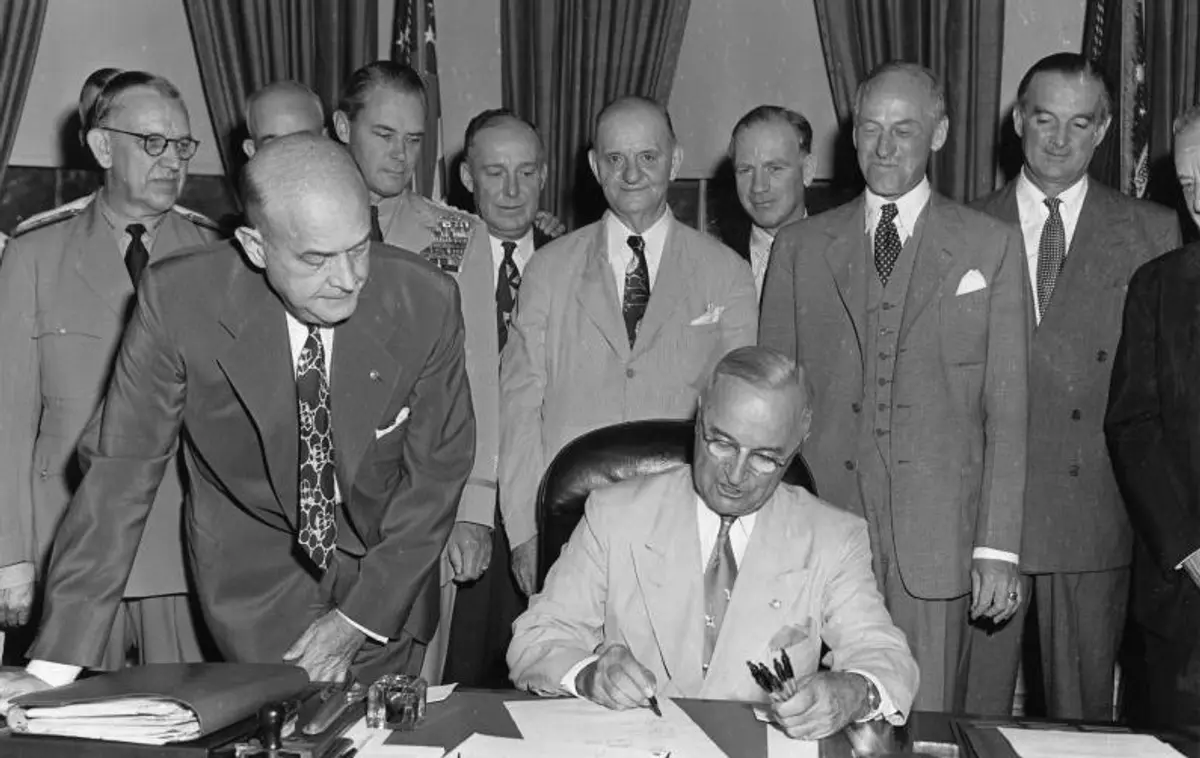
President Harry Truman signs the National Security Act Amendments of 1949 in the Oval Office. The amendments came two years after Truman first signed the National Security Act into law. (Abbie Rowe/ National Park Service/ Public Domain)
Seventy-nine years ago this month, President Harry Truman signed the National Security Act, which quickly morphed into today’s metastasizing, often abusive, national security state. With the stroke of his pen, Truman blessed the creation of the National Security Council to advise him and future executives on the integration of domestic, foreign, and military policies related to national security, ensured that each military branch retained its own intelligence functions, and created a new organization to coordinate and unify intelligence activities: the Central Intelligence Agency, or CIA. Within a decade the CIA and existing intelligence organizations were joined by the Intelligence and Research Bureau (INR) in the State Department, the Air Force Security Service (USAFSS), the Office of Special Investigations (OSI), and the National Security Agency (NSA).
Today, we often think these secretive organizations were inevitable outcomes of World War II and the Cold War. The U.S. government presumably leveraged secrecy, surveillance, and espionage to delay or thwart the Soviet Union’s atomic ambitions. Without a doubt, the Soviet threat was critical in establishing the national security state. But don’t give Stalin, Khrushchev, or the Soviet Union’s first nuclear tests all the credit. The National Security Act and what followed were also spawned by naked opportunism. Historians note that Truman’s push for an integrated national security apparatus “came about because a determined president who wanted to reshape the national security establishment took full advantage of the opportunity provided him in the wake of the largest war in history.” Though his intentions weren’t nefarious, the consequences have been disastrous, particularly for civil liberty.
Examples are plentiful. Truman’s centralization of the national security state would allow for increased migration of German scientists into the United States, including individuals responsible for war crimes against political prisoners, Romani (often referred to as “gypsies”), and Jews. These same individuals, along with other academics granted access to funding and “restricted data” courtesy of collaborations between the Atomic Energy Commission and the surveillance state, continued to experiment on human beings in the United States. The “subjects” included uninformed and non-consenting U.S. service members, pregnant women, prisoners, and mentally disabled children.
U.S. intelligence agencies, including the FBI, CIA and NSA, routinely abused their government-granted secrecy to surveil Americans domestically, from civil-rights activists like Martin Luther King Jr. and antiwar protestors during the Vietnam War, to other possible “subversives” like Albert Einstein and Aretha Franklin, along with journalists, actors, elected officials, and other Nobel laureates. These abuses were so egregious that, in 1976, a special Senate committee — the Church Committee — required seven volumes and six books to adequately report the scale and scope of the CIA, FBI and NSA abuses it had uncovered.
snip