Welcome to DU!
The truly grassroots left-of-center political community where regular people, not algorithms, drive the discussions and set the standards.
Join the community:
Create a free account
Support DU (and get rid of ads!):
Become a Star Member
Latest Breaking News
Editorials & Other Articles
General Discussion
The DU Lounge
All Forums
Issue Forums
Culture Forums
Alliance Forums
Region Forums
Support Forums
Help & Search
Environment & Energy
Related: About this forum
Detection of Offshore Wind Turbine Chemical Spallation by Non-Targeted Analysis (Mass Spec).
The paper to which I'll briefly refer in this post is this one: Nontargeted Screening to Unravel Offshore Wind Farm Chemical Fingerprints David Vanavermaete, Pablo Zapata-Corella, Karien De Cauwer, Javier Castro-Jiménez, Elena Hengstmann, Torben Kirchgeorg, Koen Parmentier, Christof Van Poucke, Putu Yolanda Yulikayani, and Bavo De Witte Environmental Science & Technology 2026 60 (19), 14108-14119
From the introduction to the paper:
Climate change has become a major environmental concern over the last decades, resulting in different efforts to reduce the impact of CO2, among other greenhouse gases. (1) Starting with the Kyoto Agreement in 1998, different policies were put into play to push toward a climate-neutral Europe by 2050. (2) Wind energy plays a crucial role herein. In the first quarter of 2025, 42.5% of the renewable energy in the EU was generated by wind, followed by hydro (29.2%) and solar (18.1%). (3) The first wind turbine to convert wind energy to electricity dates back to 1887. Since then, the offshore wind energy sector has greatly expanded. By 2025, 37 GW of electricity is expected to be produced by offshore wind farms (OWFs) in European seas, (4) and it is expected to further increase to 60 GW by 2030. (5)
Offshore wind turbines and scour protection introduce a hard substrate into the marine environment. Combined with the exclusion of fisheries, a diverse ecosystem is observed around these new structures with an increased biomass and biodiversity. (6,7) However, the wind turbines also introduce different new stressors into the environment, such as underwater noise, electromagnetic fields, and potential collisions of sea birds with rotor blades. (8,9) Therefore, the impact on marine organisms in OWFs is systematically monitored in various EU countries. (10−13) In contrast, the study of chemical emissions from OWFs has been strongly overlooked because of presumably low (and negligible) emissions compared to other sources, like the oil and gas industry. (14) Nevertheless, different potential sources are present, which could lead to a continuous, discontinuous, or accidental release of a large variety of chemical compounds and (plastic) particles. A recent comprehensive review by Hengstmann et al. (15) reported 228 chemicals potentially emitted by OWFs, including both organic (almost 70% of the listed compounds) and inorganic compounds. The effects on the marine ecosystems of either of these emitted compounds are still unclear. (16−18)...
Offshore wind turbines and scour protection introduce a hard substrate into the marine environment. Combined with the exclusion of fisheries, a diverse ecosystem is observed around these new structures with an increased biomass and biodiversity. (6,7) However, the wind turbines also introduce different new stressors into the environment, such as underwater noise, electromagnetic fields, and potential collisions of sea birds with rotor blades. (8,9) Therefore, the impact on marine organisms in OWFs is systematically monitored in various EU countries. (10−13) In contrast, the study of chemical emissions from OWFs has been strongly overlooked because of presumably low (and negligible) emissions compared to other sources, like the oil and gas industry. (14) Nevertheless, different potential sources are present, which could lead to a continuous, discontinuous, or accidental release of a large variety of chemical compounds and (plastic) particles. A recent comprehensive review by Hengstmann et al. (15) reported 228 chemicals potentially emitted by OWFs, including both organic (almost 70% of the listed compounds) and inorganic compounds. The effects on the marine ecosystems of either of these emitted compounds are still unclear. (16−18)...
I added the bold.
I disagree with the statement in the first paragraph that "Wind energy plays a crucial role herein," where "herein" refers to wind energy having any effect on addressing the collapse of the planetary atmosphere. This is nonsense on inspection. The expenditure of trillion dollars on wind energy has had no effect on the use of dangerous fossil fuels, which are now being used at the highest level ever observed, and rate the collapse of the planetary atmosphere is accelerating continuously to levels never seen in history. The chief role of the wind industry in particular and the so called "renewable energy" industry in general has been to attack nuclear energy, the only sustainable and clean form of energy now available to humanity. Wind and solar by contrast depend on access to and use of dangerous fossil fuels.
From the article it appears that the wind turbines have been assumed to be chemically benign because well...well...well...why would that be?
Assume Assume makes an ass of U and Me.
The waters around the OWFs (Offshore wind farms) were found to have generated quite a number of chemicals beyond the well known microplastics generated by collisions with dust particles, rain drops, ice, and temperature gradings interacting coatings that wind turbines release as the blades are degraded, a well known phenomenon.
Some graphics from the paper:
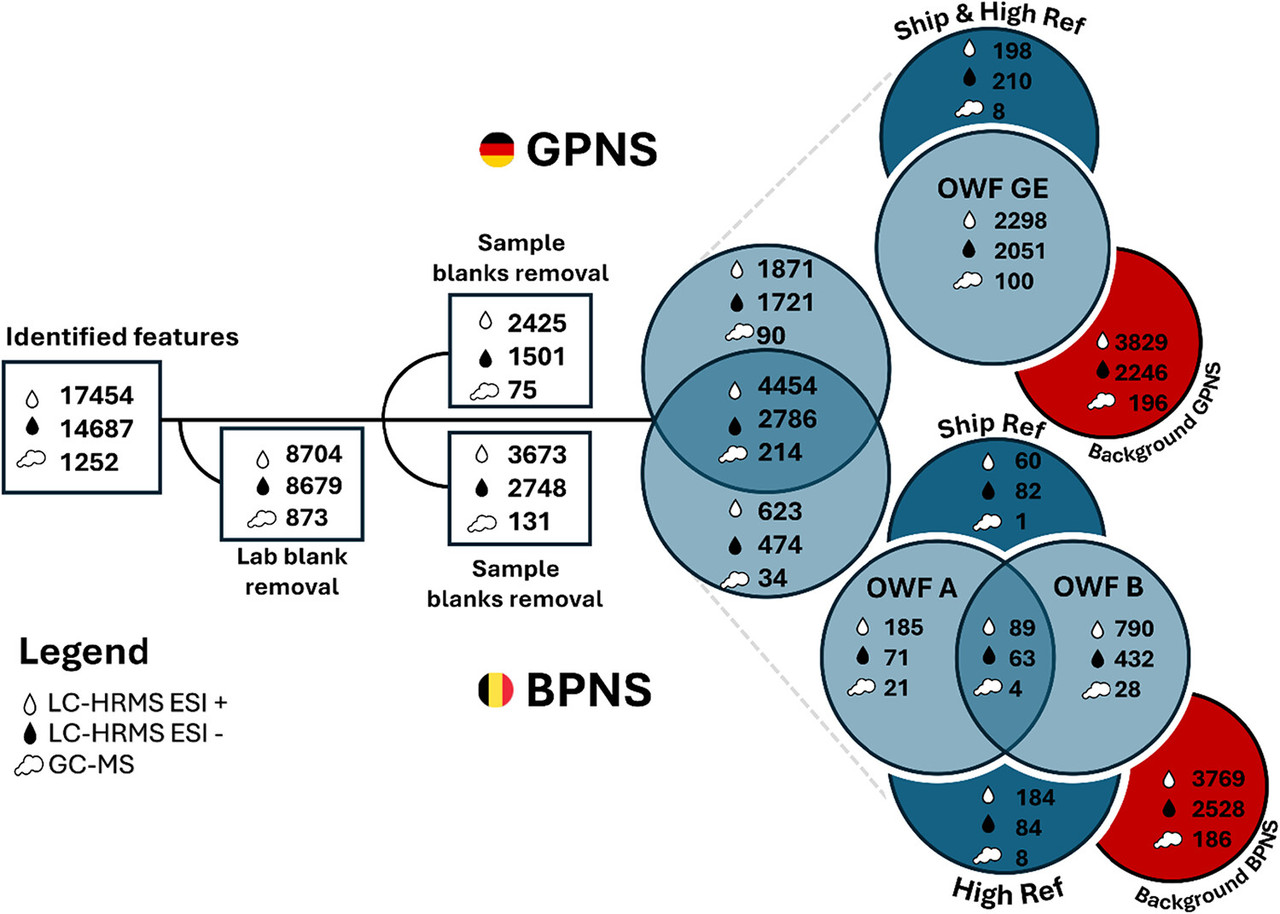
The caption:
Figure 3. Overview of the number of features detected using GC-MS and LC-HRMS in ESI ± modes after blank correction. The remaining features are divided into different categories for both the Belgian (lower) and German (upper) parts of the North Sea (BPNS and GPNS, respectively) using a score function.
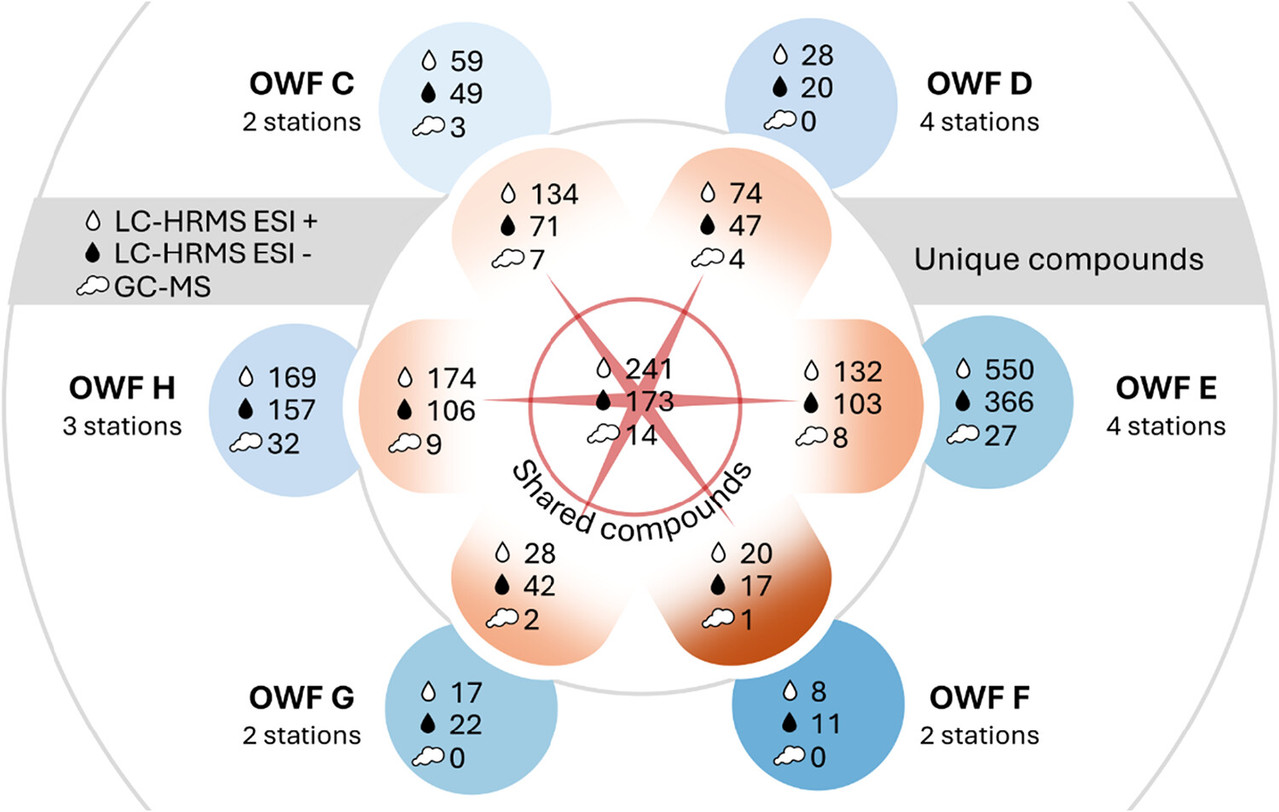
The caption:
Figure 4. Overview of the number of compounds that were more abundantly present in each German Offshore wind farm for both LC-HRMS and GC-MS. For each OWF, the number of unique compounds for each OWF is reported in the outer circles with a blue background. Those compounds that were detected in at least two OWFs were classified as shared compounds and are listed in the middle red circle. Additionally, the number of times a shared compound occurred at each OWF is given in the inner circles with a red background. For example, in OWF C, from the 241 shared compounds detected in ESI positive mode, 134 compounds were detected in OWF C. Note that some of these compounds may also be detected in other OWFs; therefore, the sum of the compounds in the red circle will always be greater than the total number of shared compounds reported in the middle.
It is not always possible in nontargeted analysis to identify every compound, although many can be found by appeal to commercial and public libraries. Some compounds represented in these chemical libraries are identified however:
...When compared to the extensive list of potential chemicals emitted by OWFs published by Zapata Corella et al., (49) only one compound, butyl acetate, was detected in the German OWFs using LC-HRMS in ESI – mode. However, when inspecting alternative hits (other than the highest-ranked hit), more overlap was found. 2-phenylphenol, nonoxynol, n-propylbenzene, tert-butylcatechol, 4-nonylphenol, n-propylbenzene, bisphenol A, bisphenol F, furfuranol, diethyl toluene-2,4-dicarbamate, and hexamethylene diamine were suggested for features found at impact locations (especially in the GPNS) in ESI + mode (LC-HRMS), and (3S,4S)-3,4-pyrrolidinediol and biuret were suggested for the ESI – mode. These compounds are used as a precursor or additive in polyurethane and epoxy-based coatings, (20,50) or are the degradation or condensation products from specific coating leachates, like toluene diisocyanate or hexane diisocyanate. (22,51)
Several PAHs were also identified. To confirm their presence, a mixture of PAHs and phenols was analyzed using the same NTS method. Eight out of the 15 PAHs were confirmed on GC-MS, whereas no phenols were found in either GC-MS or LC-HRMS (see Supporting Information S3)...
Several PAHs were also identified. To confirm their presence, a mixture of PAHs and phenols was analyzed using the same NTS method. Eight out of the 15 PAHs were confirmed on GC-MS, whereas no phenols were found in either GC-MS or LC-HRMS (see Supporting Information S3)...
Some compounds found are unknown and unidentified, others may have escaped analysis. The authors write in the conclusion:
A wide variety of chemicals were found, with a clear difference between OWFs. However, only a small portion has been identified. Compound identification in NTS is a challenging task with existing libraries and tools. For the LC-HRMS, because the data are collected in data-dependent mode, MS/MS data are not available for all features. Reinjecting the samples might help to increase the collection of MS/MS data, further enhancing the identification, but the collection will still be limited by the availability of libraries. Additionally, compounds for which no MS/MS data could be collected indicate that they did not reach a certain threshold, potentially related to low occurrence or low ionizability under the used ESI conditions.
Because the majority of the compounds are unidentified, it remains difficult to assess the risk of these (unidentified) leachates in the marine environment. Therefore, further screening is necessary to understand whether the detected compounds are persistently present in the OWFs and to what extent. In addition, target analysis can be used as a complementary approach for a quantitative determination of suspected chemicals. Biological effect monitoring or dedicated exposure experiments could help to understand the ecotoxicological effects of the mixture of leachates without the immediate need to identify the separate compounds (e.g., Alter et al. (68)), but to ensure a safe environment, hazardous substances should be identified and monitored on a regular basis, which would require further research.
Because the majority of the compounds are unidentified, it remains difficult to assess the risk of these (unidentified) leachates in the marine environment. Therefore, further screening is necessary to understand whether the detected compounds are persistently present in the OWFs and to what extent. In addition, target analysis can be used as a complementary approach for a quantitative determination of suspected chemicals. Biological effect monitoring or dedicated exposure experiments could help to understand the ecotoxicological effects of the mixture of leachates without the immediate need to identify the separate compounds (e.g., Alter et al. (68)), but to ensure a safe environment, hazardous substances should be identified and monitored on a regular basis, which would require further research.
Someone is likely to argue that petroleum drilling off shore is worse for chemical impact, but then again, wind energy has nothing to do with addressing petroleum use; the effect of the vast wind industry in Germany has not eliminated the use of fossil fuels there, although its dubious claims of cleanliness was utilized in a paroxysm of ignorance to shut clean energy, of which there is but one form, nuclear energy, in favor of fossil fuels.
I trust you're having a pleasant week.