Environment & Energy
Related: About this forumThe World Inventory of Used Nuclear Fuel as of 2025 Stood at 447,758 Metric Tons.
The IAEA has built a very nice graphic heavy website discussing the world inventory of used nuclear fuel, that is all of fuel that has gone at least once through the core of an operating nuclear reactor.
The site as a Czech address: Spent Fuel Management
It contains little text and is entirely graphic. Here is the graphic that one gets if one clicks on the left hand circle at the home page:
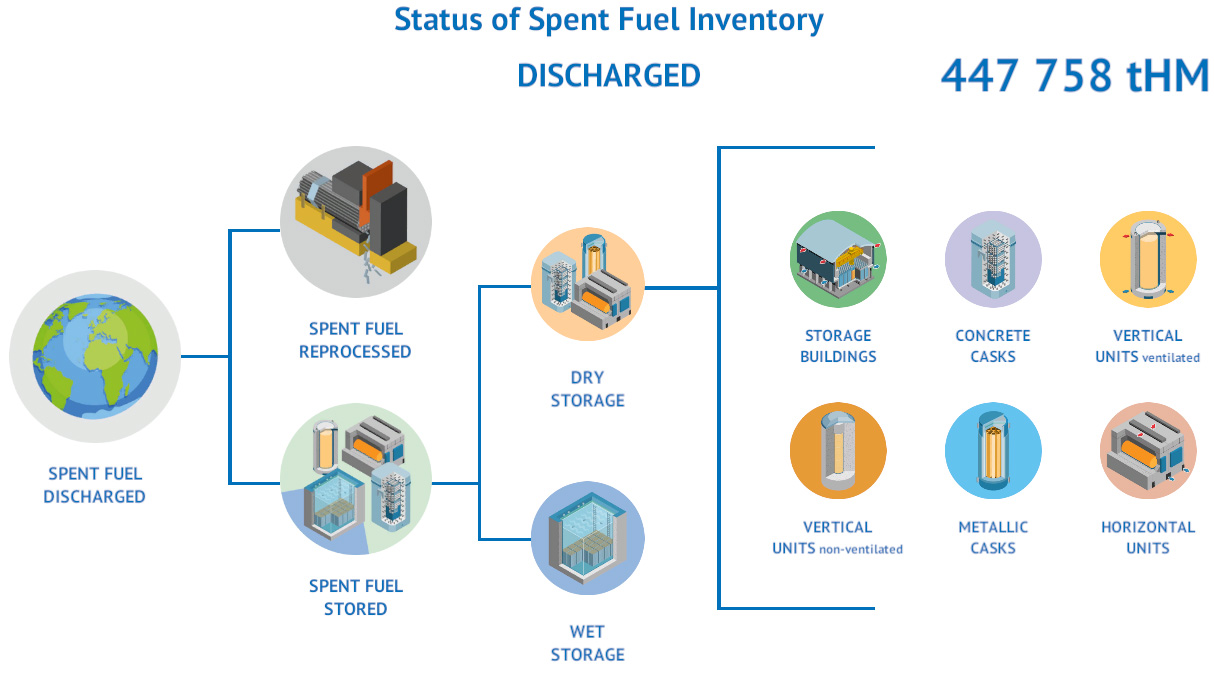
The interesting thing about this graphic is that it shows something about nuclear energy that no other form of energy can achieve: It shows where and how the used fuel is is contained. By contrast, for one example, no one knows on an industrial scale commensurate with its use, how to contain and where to contain fossil fuel waste, chiefly carbon dioxide, but also consisting of dangerous aerosols containing powerful carcinogens and free chemicals such as nitric and sulfuric acid precursors, not to mention heavy metals like the neurotoxins lead and mercury, as well as other physiologically destructive elements including but not limited to cadmium, arsenic, and, um, yes, uranium.
By contrast, all of the used nuclear fuel is contained in one form or another, in buildings, in casks, and in wet storage, generally in pools for the first several years after removal from the reactor core. Basically we know where it is.
One can click on the icon for "reprocessed" to learn the following:
About 28.1% of this fuel has been reprocessed to recover the unreacted uranium (which as a rule of thumb is about 95% unreacted uranium) as well as the valuable plutonium in the fuel, representing about 1%, again as a rule of thumb) of the content of the fuel.
A graphic table breaks down by country, from most to last, of the countries that have reprocessed their used nuclear fuel and how much of it. Two countries, the UK and France dominate this list. I was somewhat surprised to see that the UK has actually reprocessed more used fuel than France.
The UK has about 140 metric tons of civil plutonium in inventory. This valuable material is currently targeted to be immobilized for disposal, which I personally consider a crime against humanity. A kg of plutonium when completely fissioned will yield about 80 trillion Joules of energy, 80 TJ. It follows that 140 metric tons represents about 11.2 Exajoules of primary energy. For comparison, all of the unreliable and fossil fuel dependent solar energy on the entire planet, built at a cost of trillions of dollars and having a lifetime of around 25 years, produces about 9 Exajoules of energy per year. (World Energy Demand is on the order of 650 Exajoules per year, with around 80% of that figure coming from fossil fuels.)
I mean can't they just give it to someone who knows what to do with it? It's just insane to throw it away.
The world needs to prevent the disposal of this plutonium, which is also, because of the relatively short half-life of plutonium's 241Pu isotope, coupled with the long time the isolated plutonium has been stored, as it decays into the americium isotope 241Am, a source of americium, an element with fascinating and important nuclear properties.
One can click around the graphics on the website, to learn all sorts of things about valuable used nuclear fuel, for instance, using the map on the Home Page, that the United States has about 21.2% of the world's inventory of used nuclear fuel, 94,926 metric tons. This is a huge resource available for future generations. Although nuclear advocates like myself have not necessarily been happy about this, in many ways it has proved to be advantageous, since we have old nuclear fuels, some more than a half a century old, from which recovery of valuable fission products will be relatively straight forward. In my opinion though, there are a lot of advantages in the quick turnaround of used nuclear fuels while still hot, which would require the abandonment of the traditional industrial scale solvent extractions used in the process.
Using the "rules of thumb" previously mentioned we can do a "back of the element" calculation to determine how much energy is contained in the used nuclear fuel, assuming all of the actinides, including all of the 238U, so called "depleted uranium," by transmutation into plutonium.
If 95% of this heavy metal is unreacted uranium, transmuted into plutonium, at 80 trillion Exajoules per kg, this would amount to 34 Zettajoules, (3,400 Exajoules), which at current energy usage is equivalent to 52 years of current energy demand worldwide at roughly 650 EJ/year, all the oil, all the coal, all the gas, all the so called "renewable energy" hydro, solar, wind, biofuels, everything.
1% of plutonium, already present would add another 350 EJ to this figure. The other actinides, such as neptunium, americium and curium, could add additional energy. In a continuous recycling program, we might be able to produce significant inventories of the transuranium actinides up to and including Californium.
There is, I confess, some hand waving in this post, as transmuting 238U into 239Pu requires both infrastructure and time, which is why it would be disgraceful to throw any isolated existing plutonium away. (For the time being, enrichment facilities will be required to scale nuclear energy to a scale to eliminate fossil fuels as quickly as possible. Ultimately, with the incorporation of thorium from lanthanide mine tailings, enrichment can be phased out.)
There is also considerable energy content in moderately long lived fission products such as 90Sr, 137Cs and others which have significant heat loads that could operate in thermoelectric devices such as those that power deep space probes like Voyager.
Anyway, this offering from the IAEA represents a very nice website. I've bookmarked it for quick reference for the type of BOE calculations I do all the time.
Have a nice evening.
 = new reply since forum marked as read
Highlight:
NoneDon't highlight anything
5 newestHighlight 5 most recent replies
= new reply since forum marked as read
Highlight:
NoneDon't highlight anything
5 newestHighlight 5 most recent replies

OC375
(1,208 posts)
NNadir
(38,853 posts)It reminds me of the early days of Biotech, and software, where some people did get very rich.
Some of them will lose heavily I predict, particularly those investing in fusion hype.
Many of the fission based investments will also be losers, but some will be big winners, like Oklo for instance and others.
In the last several weeks, two new nuclear reactor types went critical - at near zero power however - six others will probably do so in 2026 in the US alone.
We are entering a new nuclear Era, where the creativity in reactor designs is going wild, comparable to the First Nuclear Era covered by Alvin Weinberg in his book on the subject, which my son ripped off from me (albeit with my permission). A lot of what was learned in the first nuclear Era from the late 40's through the early 1960s is being dusted off and studied. This is a very good thing, too little, too late perhaps to have avoided the ongoing tragedy of fossil fuels, and maybe too little to late to slow the destruction, but we must do what is possible, including some of what we regard - until we learn better - as impossible.