Neolithic 'amphitheater' uncovered at Karahantepe archaeological site
"The main purpose was to bring people together. This design continued in later eras in the form of amphitheaters and odeons,” said Prof. Karul.
BIA News Desk
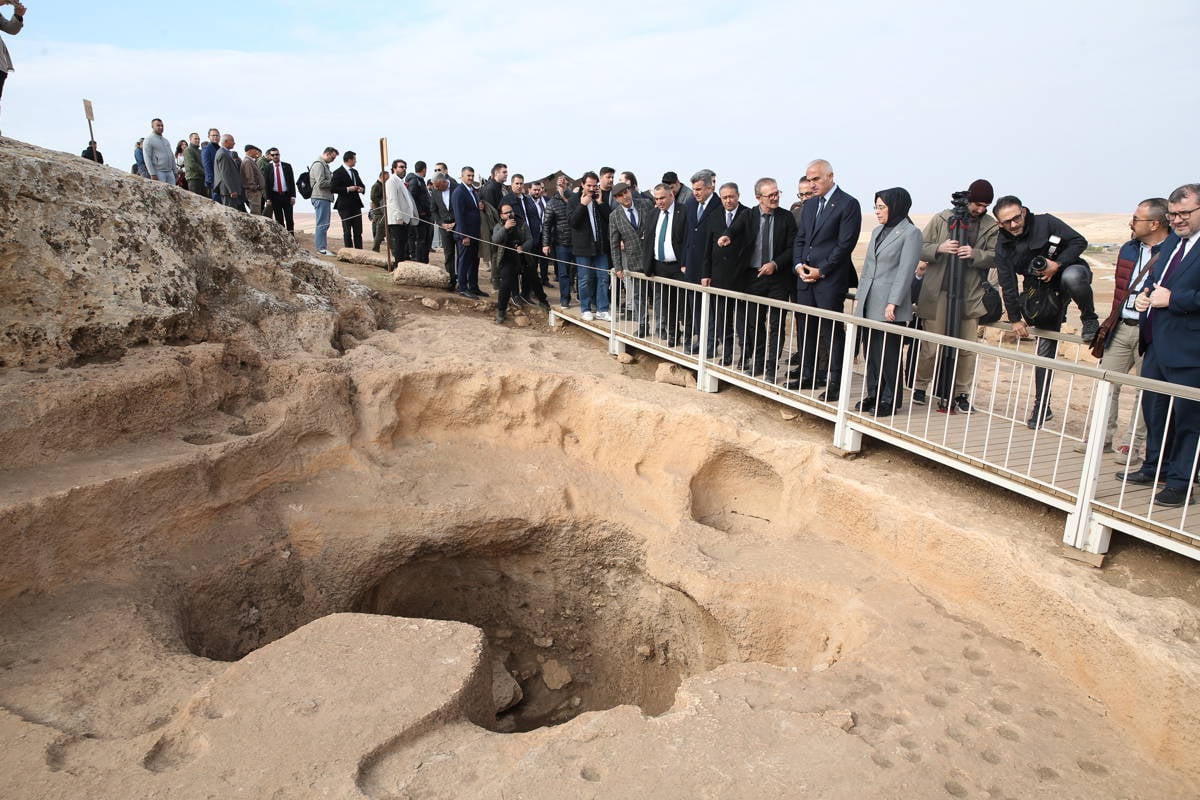
After the discovery, Culture and Tourism Minister Mehmet Nuri Ersoy visited Karahantepe on Nov 26 (Photos: AA)
Archaeologists working at the Karahantepe excavation site in southeastern Turkey have discovered a Neolithic-era structure resembling an amphitheater, along with a human-shaped statue, Anadolu Agency (AA) reported.
Located within the Tek Tek Mountains National Park in Şanlıurfa province, excavations at the site has gained momentum through the Culture and Tourism Ministry’s "Legacy to the Future" project. Excavations aim to shed light on the lives and rituals of early human communities.
Excavation head Prof. Necmi Karul told AA that settlement at Karahantepe began around 9400 BCE and continued into the 8000s BCE. He explained that three distinct architectural phases have been identified at the site.
In the earliest phase, structures had circular plans; in the second phase, they became rectangular with rounded corners; and in the final stage, buildings featured sharp corners. Public and residential buildings were found across all phases.

The amphitheater-like site
Karul noted that unique artifacts have been unearthed during ongoing digs inside residential structures, including the area where a 2.3-meter human statue was previously found.
“We’ve reached the bedrock throughout the structure, which is roughly 17 meters in diameter,” he said. “We discovered human heads embedded in the walls and seated human statues scattered across the floor. These are very unique finds.
More:
https://archive.is/J0Iwq#selection-797.0-807.233
