Latest Breaking News
In reply to the discussion: 'Don Colossus' -- a 22-foot tall Golden statue of Trump -- is set to rise where US will host world leaders for G20 [View all]
Kid Berwyn
(23,591 posts)Why "Crypto Guys" don't pay for vagina neck:
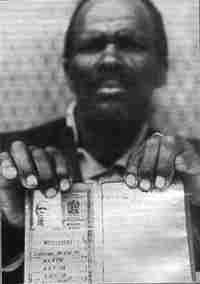
The Use of Computers to Support Oppression
Computer technology enabled the government to organize and enforce such an atrocious system of segregation and control.
More than any other single technological advancement, the computer fostered the concentration of administrative power in the hands of Africa's white elite. (NAR82)
Despite the U.N. arms embargoes, American computers were in widespread use throughout South Africa. The United States was the largest supplier of computers used in South Africa. American computers were in use in virtually every governmental agency, the police system, and the military, all of which contributed to the control system known as apartheid. Computer technology did not merely support the system of oppression, rather the entire country was utterly dependent upon it. As the managing director of the South African subsidiary of Burroughs Corporations said,
We are entirely dependent on the U.S. The economy would grind to a halt without access to the computer technology of the West. No bank could function; the government couldn't collect its money and couldn't account for it; business couldn't operate; payrolls could not be paid. Retail and wholesale marketing and related services would be disrupted. (NAR82)
The extensive history of the export of American computer technology began in 1952 with an order for the first "electric tabulator" to IBM-South Africa. Three years later, the streamlining of the hated pass system resulted in an automated population register implemented on foreign computers. 1970 found South Africa with an estimated four hundred computers -- a value of about one hundred million dollars. The number of computers continued to grow, totaling more than forty five hundred in 1982. In 1977, only the U.S. and Britain spent more on computer technology than South Africa as a percentage of gross national product, while in 1980, 75% of the computers in South Africa were purchased from American corporations. South Africa continued to import a large number of computers despite an attempt by the government to promote domestic production. Local products accounted for less than 5% of South African computer equipment sales in 1988. Many of these sales occured despite restrictions in U.S. law.
American corporation IBM was the largest computer supplier in South Africa throughout the years of apartheid. In 1978 alone, IBM's South African sales jumped 250%; total annual sales amounted to approximately three hundred million dollars in 1982. Not only did IBM contribute tremendous computing power to the South African apartheid system, but of the fifteen hundred South African workers employed by IBM in 1982, less than 20% were classified as coloured, black or Asian. IBM continually asserted that the applications of their computers were not used to abridge human rights, despite acknowledgment that the uses to which their computers were put could not be known in all cases. In fact, the South African Parliament made it illegal for companies to report the uses of their computers. Although IBM officially divested from South Africa in 1987, their products continued to be distributed by Information Services Group.
CONTINUED...
http://www-cs-students.stanford.edu/~cale/cs201/apartheid.comp.html
Edit history
Recommendations
0 members have recommended this reply (displayed in chronological order): = new reply since forum marked as read
Highlight:
NoneDon't highlight anything
5 newestHighlight 5 most recent replies
RecommendedHighlight replies with 5 or more recommendations
= new reply since forum marked as read
Highlight:
NoneDon't highlight anything
5 newestHighlight 5 most recent replies
RecommendedHighlight replies with 5 or more recommendations